by Vincent Juico
John McLendon was never the loudest figure in basketball history, nor the most commercially celebrated. But few men shaped the sport more profoundly. Long before fast breaks became standard, before racial integration reshaped college athletics, and before Black coaches were welcomed into the mainstream of American sports, McLendon was already decades ahead of his time.
His life reads less like a coaching résumé and more like a blueprint for modern basketball.
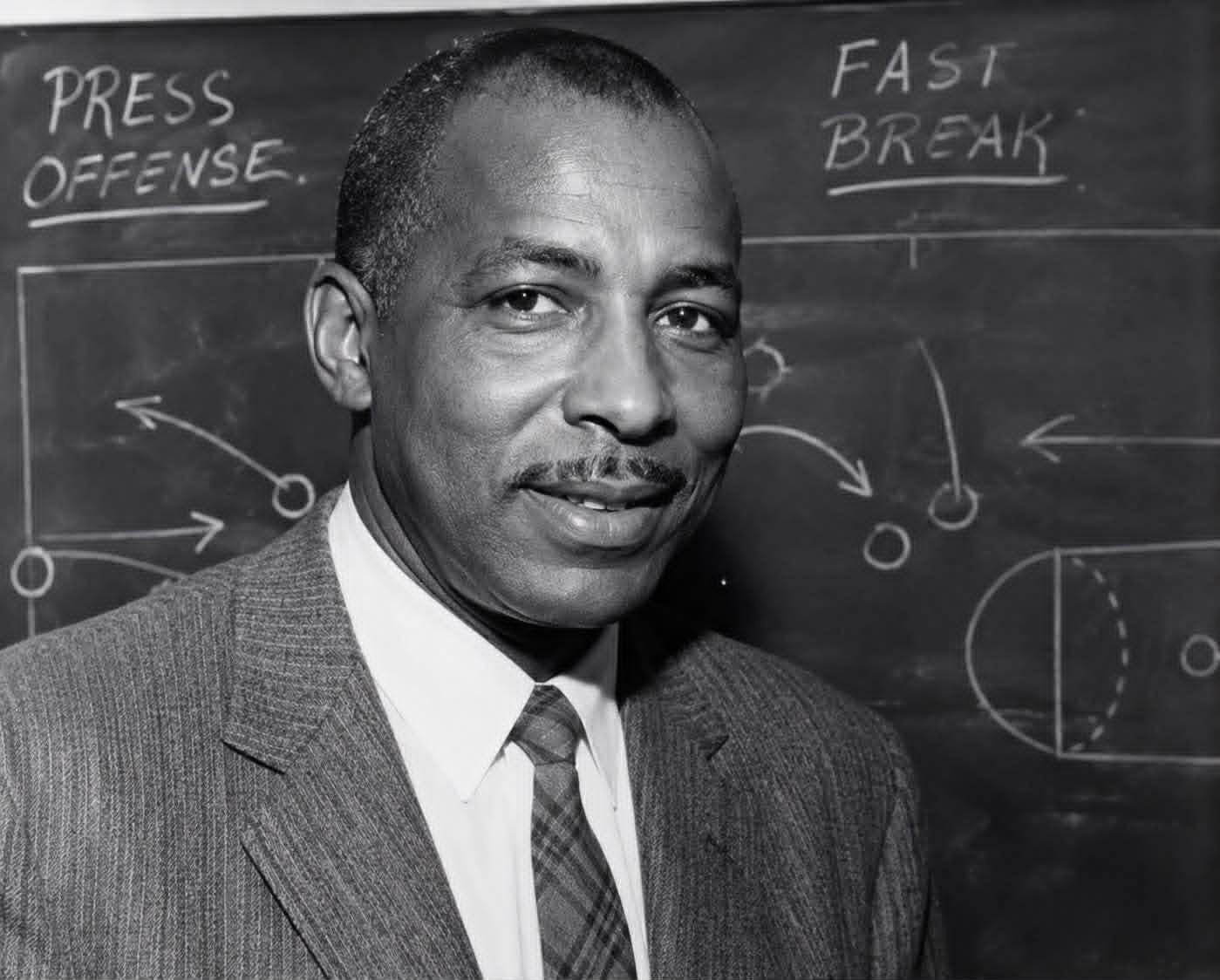
Born in 1915 in Kansas, McLendon’s basketball education began under the legendary James Naismith himself at the University of Kansas. That connection alone places him near the roots of the game. Yet McLendon’s journey would become something far more significant than merely learning from basketball’s inventor. He became one of the sport’s great innovators and one of its most important agents of social change.
At a time when segregation infected every layer of American life, McLendon coached at historically Black colleges because major white universities would not hire Black coaches. Instead of bitterness, he responded with invention. His teams played at a breathtaking pace. He emphasized conditioning, speed, relentless pressure, and quick scoring long before those concepts became fashionable. What today resembles modern transition offense and full-court pressure was, in many ways, McLendon basketball.
Decades before the NBA’s pace-and-space era, McLendon understood that speed could become both a weapon and a philosophy.
His greatest coaching achievements came at Tennessee State University, where he led the Tigers to three consecutive NAIA national championships from 1957 to 1959. He led the first historically Black program to accomplish such dominance on a national stage. The victories mattered beyond the scoreboard. In segregated America, every championship challenged the myth that Black athletes and Black coaches were somehow inferior in intelligence, organization, or leadership.
McLendon was coaching basketball, but he was also coaching dignity.
One of the defining moments of his life came in 1944 with the now-famous “Secret Game” between the North Carolina College for Negroes and the white Duke University medical school team. At a time when interracial competition was effectively forbidden in the South, the game was played behind closed doors in silence and secrecy. McLendon’s team reportedly won decisively, but the final score mattered less than the symbolism. The contest represented resistance through sport, a quiet but powerful act against segregation.
Basketball history often remembers pioneers only after society becomes comfortable with their ideas. McLendon fits that pattern perfectly.
The irony of his career is striking. Many coaching philosophies celebrated today, like the uptempo offense, aggressive pressing defenses, and maximizing athleticism, trace directly to concepts McLendon taught generations earlier. Coaches such as Dean Smith and Adolph Rupp studied elements of his system. His fingerprints exist all over the modern game, even when his name is omitted from mainstream basketball conversations.
Yet perhaps McLendon’s greatest legacy was not tactical but moral.
He represented the possibility that excellence could survive exclusion. He proved that innovation could emerge from marginalized spaces. And he forced American basketball to confront its own contradictions in a sport that was invented as a democratic game but, for decades, denied equal opportunity to many of its finest minds.
Today, every high-tempo offense, every pressing defense, every Black head coach thriving at the highest levels of basketball carries a small echo of McLendon’s influence.
History eventually inducted him into the Naismith Memorial Basketball Hall of Fame, but honors alone cannot fully capture his significance. John McLendon was not merely ahead of his time. In many ways, basketball is still catching up to him.

"Marvelous" Marvin Nathaniel Hagler had knockout power in both hands. He could fight either southpaw or unorthodox, anything to keep Read more
Wataru Misaka was 5-foot-7 and was drafted by the New York Knicks of the then BAA (Basketball Association of America), Read more

BaliPure Purest Water Defenders Head Coach Rommel Abella mentioned the word positionless, which is a word you normally associate with Read more
![Stephen Curry [photo credit: Wikimedia Commons | TechCrunch]](https://sportsbytes.com.ph/wp-content/uploads/2021/04/TechCrunch_Disrupt_San_Francisco_2019_-_Day_1_48835097887_cropped-scaled.jpg)
As the nation observes holy week, in my 45 years of existence, I've seen athletes both professional and amateur, wear Read more

- MVP MMA Takes Aim - August 13, 2026
- The Heart of Resilience - July 27, 2026
- The Tartan Army and the Orange Army: What American Sports Can Learn from Football’s Greatest Traveling Fans - June 26, 2026