by Vincent Juico
There are scorers who fill up a box score, and then there was Oscar Schmidt, a player whose entire basketball identity was built on repetition, fearlessness, and an almost stubborn refusal to believe a shot was ever a bad idea.
In modern terms, Schmidt would be described as a high-volume scoring wing with elite shooting touch and extreme usage. In his own era, he was something simpler and more radical.
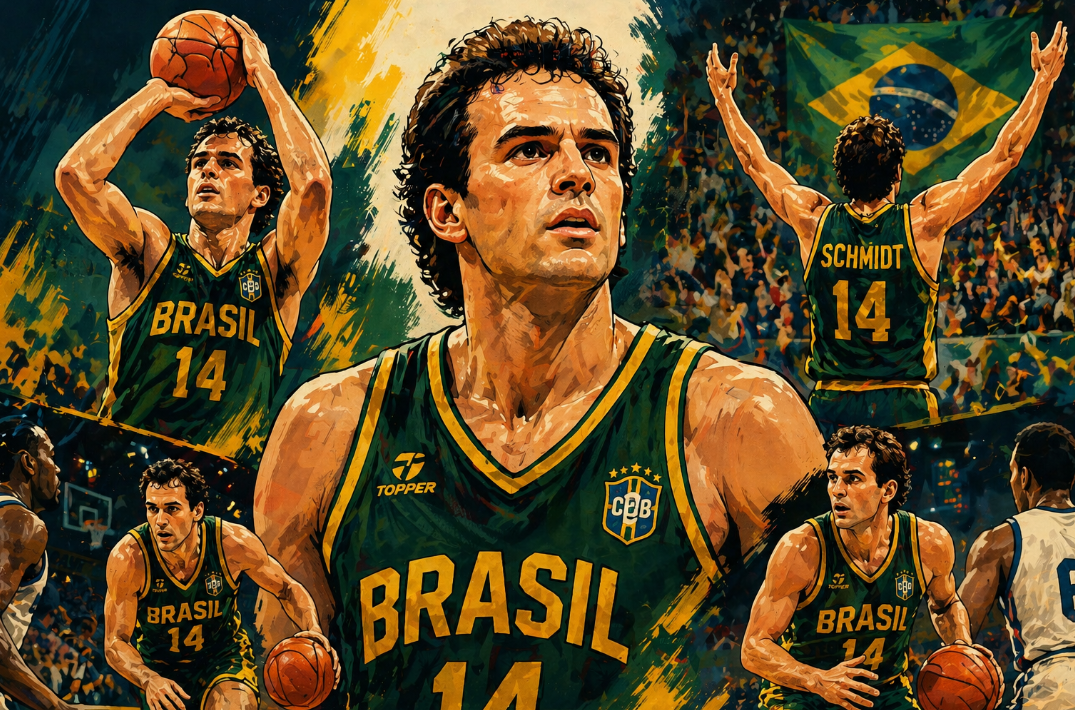
He was a man who scored because that was what he did, and did it better than almost anyone in the world.
Schmidt’s career defies the modern obsession with efficiency. He was not a “selective” scorer. He was a constant scorer. Catch, rise, release, mid-range, long two, occasional three, and a rhythm that rarely wavered no matter the context or defender.
What separated him wasn’t just accuracy, but mentality. Where most scorers escalate aggression based on matchup or momentum, Schmidt began at maximum volume and stayed there. In today’s NBA, that approach would be heavily scrutinized. In international basketball of his era, it was devastating.
The result: a career scoring total that stretches into the stratosphere of basketball history, with over 49,000 points accumulated across club and international play. It is a number that doesn’t just signal longevity, it signals relentless offensive responsibility carried over decades.
Perhaps the most fascinating subplot in Schmidt’s legacy is the one he never wrote: the NBA career.
Drafted in 1984 by the New Jersey Nets, Schmidt chose a different path, committing himself to international basketball and the Brazilian national team. In doing so, he sacrificed visibility but gained something rarer in that era, total offensive freedom.
Had he entered the NBA, his career would have inevitably been shaped by structure: shot selection discipline, reduced usage, and role definition. Instead, he remained the primary offensive engine wherever he played.
That decision has created a permanent tension in his legacy. Was he the greatest scorer outside the NBA system, or one of the most under-examined offensive talents of his generation? The truth likely sits between admiration and uncertainty.
In today’s NBA, Schmidt would not be a novelty, he would be a tactical weapon.
In a modern system, coaches would almost certainly refine his shot diet. Fewer long twos, more threes, more structured movement shooting sets. But the core value would remain unchanged. Schmidt generated points without hesitation.
He would likely function as a high-end secondary scorer or elite spacing threat, similar in offensive gravity to modern catch-and-shoot stars but with far greater willingness to self-create volume.
No honest evaluation of Schmidt can avoid the defensive reality. He was not a stopper, nor was he built for the switch-heavy demands of today’s perimeter defense. Against elite athletic wings, he would have required system protection.
But basketball history is not a checklist of two-way perfection. It is also a record of specialists who bent games in one direction so consistently that the imbalance itself became a weapon. Schmidt belonged to that category.
What elevates Schmidt beyond statistical curiosity is where he did his damage. International basketball was not a side stage for him, it was the main event. Olympic tournaments, FIBA competitions, and European club battles formed the backbone of a career defined by national pride and offensive leadership.
He became the face of Brazilian basketball for an entire generation, carrying scoring responsibility in ways few players in any country ever have.
Oscar Schmidt is difficult to place in neat historical categories because he played a version of basketball that no longer quite exists.
One where a single player could define possession after possession through sheer willingness to shoot.
He was not shaped by efficiency culture. He predated it. And yet, in today’s spacing-driven game, he would feel strangely familiar, as an early prototype of the modern offensive philosophy taken to its most extreme conclusion.
In the end, Schmidt’s legacy is not about what he lacked. It is about what he never hesitated to do.
He didn’t manage possessions.
He owned them.

"Marvelous" Marvin Nathaniel Hagler had knockout power in both hands. He could fight either southpaw or unorthodox, anything to keep Read more
Wataru Misaka was 5-foot-7 and was drafted by the New York Knicks of the then BAA (Basketball Association of America), Read more

BaliPure Purest Water Defenders Head Coach Rommel Abella mentioned the word positionless, which is a word you normally associate with Read more
![Stephen Curry [photo credit: Wikimedia Commons | TechCrunch]](https://sportsbytes.com.ph/wp-content/uploads/2021/04/TechCrunch_Disrupt_San_Francisco_2019_-_Day_1_48835097887_cropped-scaled.jpg)
As the nation observes holy week, in my 45 years of existence, I've seen athletes both professional and amateur, wear Read more

- MVP MMA Takes Aim - August 13, 2026
- The Heart of Resilience - July 27, 2026
- The Tartan Army and the Orange Army: What American Sports Can Learn from Football’s Greatest Traveling Fans - June 26, 2026