by Vincent Juico
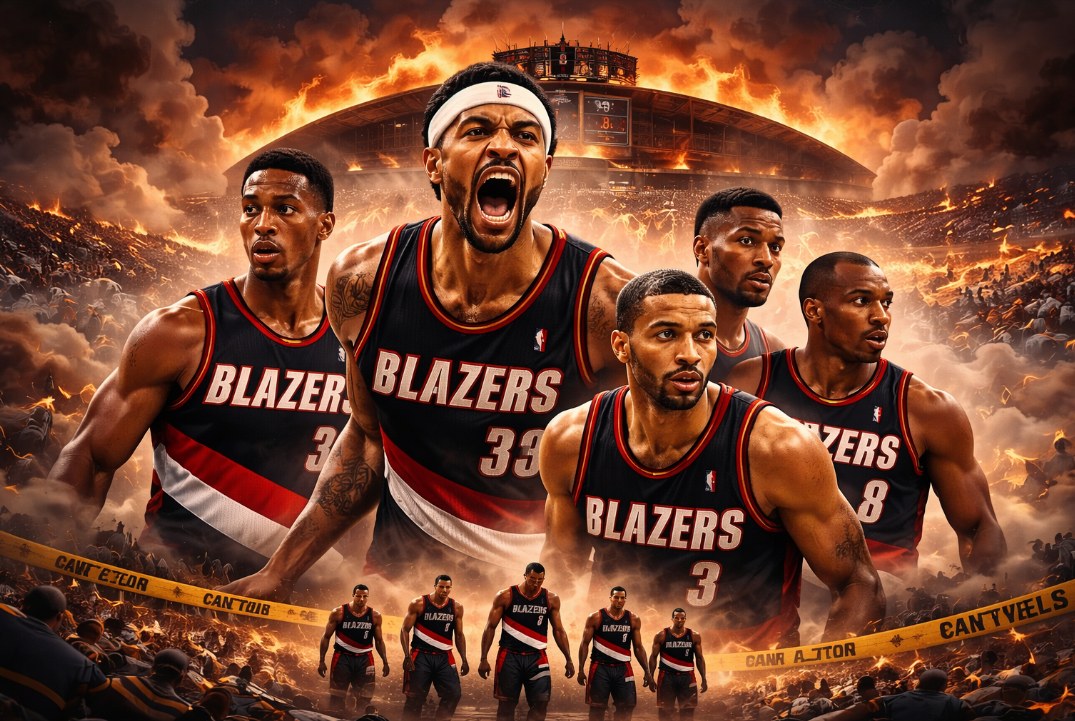
There are NBA teams remembered for what they won. Others are remembered for what they almost became. The late 1990s and early 2000s Portland Trail Blazers belong firmly in the second category one of the most talented rosters of its era, and one of the most famously self destructive.
They were so gifted, so deep, and so often undone by themselves that they earned an unwanted nickname the Jailblazers. It was not a flattering label, but it stuck because it captured a truth Portland could never quite shake this was a team constantly battling its own reflection.
On paper, Portland was terrifying.
They had length, athleticism, scoring, and depth that most contenders could only dream of. At various points, the Blazers featured a core of players like Rasheed Wallace, Damon Stoudamire, Scottie Pippen, Steve Smith, and a deep supporting cast that could rotate like a machine. They could defend multiple positions, push pace, and match up with anyone in the league.
This was not a flawed roster. It was a stacked one.
And yet, that might have been part of the problem.
Because talent without structure in the NBA does not just drift, it compounds pressure. Expectations grow faster than accountability. And Portland, under that weight, often cracked at the worst possible moments.
The Jailblazers label did not come from nowhere. It grew out of repeated off court incidents, suspensions, and a growing perception that Portland’s locker room culture lacked control.
It is important to be careful here this was not a team of criminals. But it was a team that became associated with discipline issues such as marijuana suspensions, confrontations with officials, internal friction, and a general sense that focus was not always where it needed to be.
In a league where marginal edges decide championships, perception becomes reality quickly. Opponents did not just see Portland as talented, they saw them as vulnerable to implosion.
If there is a single snapshot of the Jailblazers era, it is the 2000 Western Conference Finals against the Los Angeles Lakers.
Portland had them on the ropes, literally minutes away from the NBA Finals. They were leading Game 7 in the fourth quarter. The championship was in their hands.
Missed rotations. Hesitation. Tightness in the final minutes. And most famously, a blown 15 point fourth quarter lead that ended in heartbreak as the Lakers stormed back.
That game did not just cost Portland a Finals appearance. It defined an era.
Because great teams are remembered for closing. Portland became remembered for not closing.
No player symbolises the Jailblazers more than Rasheed Wallace.
A dominant big man with rare skill for his size.
With shooting touch, defensive versatility, and intensity, Wallace could swing games on both ends. But he was also the emotional barometer of the team.
He was brilliant, volatile, and constantly walking the line between control and chaos.
He led the league in technical fouls multiple times. He argued with referees, teammates, and sometimes the game itself. And yet, when focused, he was nearly unstoppable.
The contradiction defined Portland elite ability paired with emotional instability.
It would be too easy to blame individuals. But Portland’s story is also about organisational identity.
The Blazers of that era existed in a space between rebuilding and contending, always good enough to believe, never disciplined enough to finish. They cycled talent without fully reshaping culture. And in the NBA, culture is not abstract it shows up in late game execution, in bench discipline, and in whether a team tightens or trusts under pressure.
Today, the Jailblazers label feels like a relic of a different NBA era, one where off court behaviour was amplified differently and media narratives hardened quickly. But the basketball lesson remains relevant.
That Portland team is remembered not because it lacked talent, but because it proved something uncomfortable that talent does not automatically produce stability. And stability is what wins in June.
The Blazers of that era were never short on ability. They were short on control when it mattered most.
And that is why they remain one of the most fascinating cautionary tales in modern NBA history, a team that could beat anyone on any night, and still found a way to beat itself when everything was on the line.

"Marvelous" Marvin Nathaniel Hagler had knockout power in both hands. He could fight either southpaw or unorthodox, anything to keep Read more
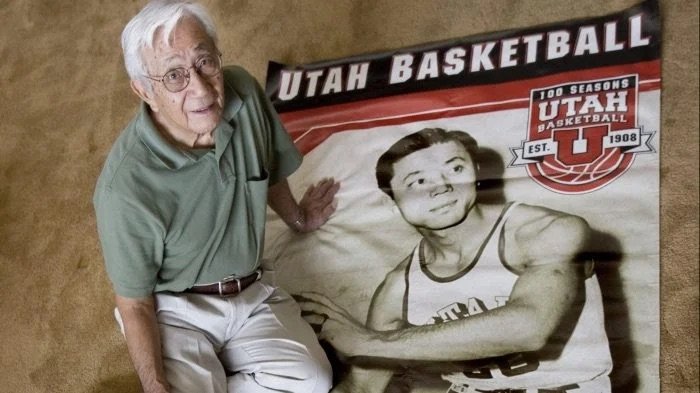
Wataru Misaka was 5-foot-7 and was drafted by the New York Knicks of the then BAA (Basketball Association of America), Read more

BaliPure Purest Water Defenders Head Coach Rommel Abella mentioned the word positionless, which is a word you normally associate with Read more
![Stephen Curry [photo credit: Wikimedia Commons | TechCrunch]](https://sportsbytes.com.ph/wp-content/uploads/2021/04/TechCrunch_Disrupt_San_Francisco_2019_-_Day_1_48835097887_cropped-scaled.jpg)
As the nation observes holy week, in my 45 years of existence, I've seen athletes both professional and amateur, wear Read more

- MVP MMA Takes Aim - August 13, 2026
- The Heart of Resilience - July 27, 2026
- The Tartan Army and the Orange Army: What American Sports Can Learn from Football’s Greatest Traveling Fans - June 26, 2026