Strength training has become the default workout choice for millions worldwide, supported by fitness apps, wearables, and AI-powered tracking tools. However, the rapid rise of strength-focused exercise has not been matched by confidence or clarity, according to the 2026 Global Fitness Report released by Les Mills.
Based on responses from 10,442 participants across five continents, the report highlights a widening gap between motivation and capability. While more people want to lift weights, many remain unsure how to begin, progress, or train safely.
The findings suggest that despite the availability of digital tools and information, uncertainty around technique and programming continues to affect participation and long-term consistency.
Confidence and guidance remain the biggest barriers
The report shows that 54 percent of aspiring lifters do not know where to start, while 50 percent feel intimidated by the weights area. Even among current gym-goers, confusion persists, with 58 percent citing conflicting advice as a barrier to effective training.
Notably, 30 percent of self-identified advanced lifters said they are unsure how to progress their workouts. Meanwhile, 33 percent of lifters reported feeling out of place on the gym floor, despite strength-based group formats becoming the most popular studio category globally.
Strength-focused classes grew from 30 percent of studio participation in 2018 to 36 percent in 2025. The report notes that coached group environments play a critical role in building confidence and reducing “gymtimidation,” particularly for those navigating strength training for the first time.
Les Mills Head of Research Bryce Hastings said technology continues to shape fitness, but human connection remains central. He emphasized that live classes maximize the “group effect,” driving higher enjoyment, satisfaction, and effort through shared experience and expert instruction.
Human-led coaching outpaces AI in fitness
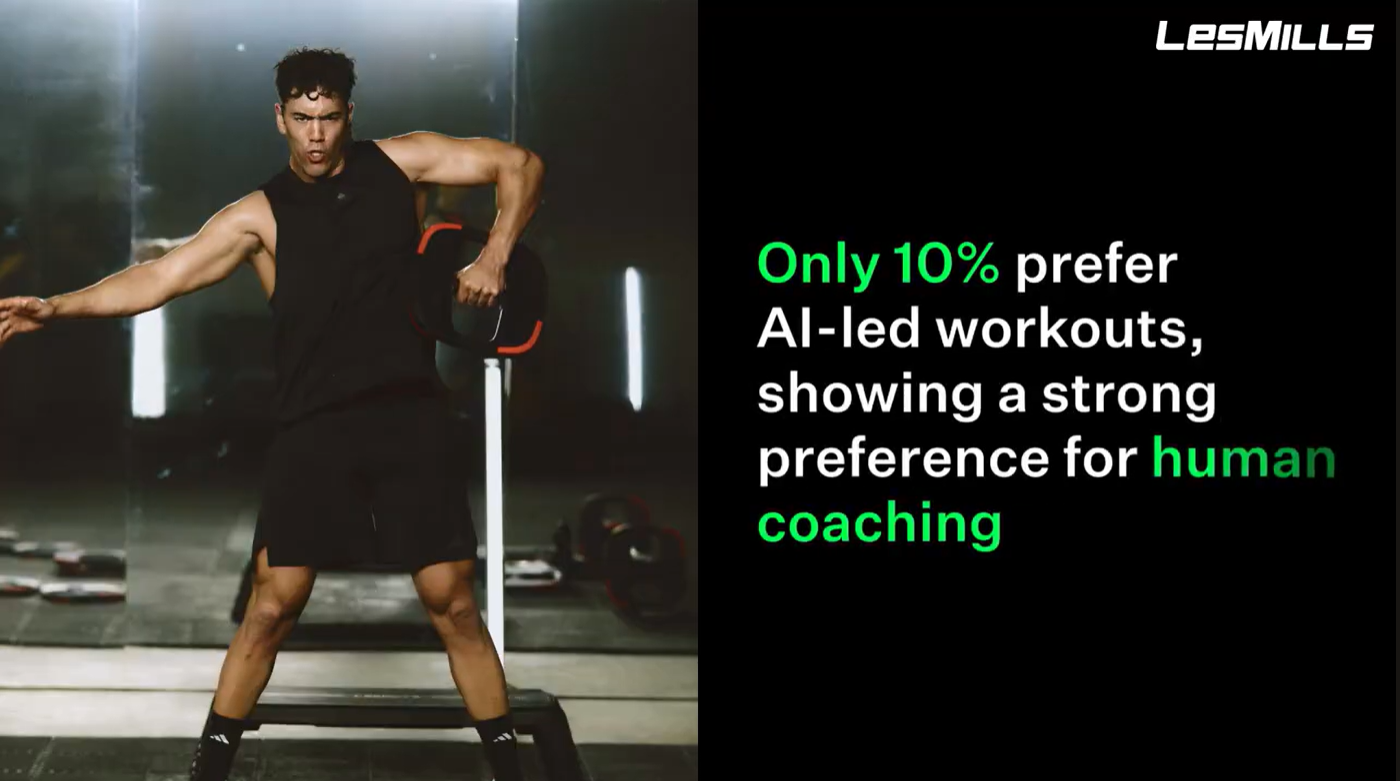
While technology remains a key part of the modern fitness journey, the report shows exercisers prefer people, not machines, to lead workouts. Only 10 percent of adults, including 11 percent of Gen Z, said they would choose an AI coach over a human instructor.
At the same time, 78 percent of respondents said they are using fitness devices and tracking tools the same or more than three years ago. This supports what Les Mills describes as a “track with tech, train with people” model for fitness clubs.
Les Mills Asia Pacific CEO Ryan Hogan said the industry is at a defining moment. He noted that while strength training is firmly mainstream, confidence has not kept pace, creating a major opportunity for operators.
Hogan stressed that growth will not come from adding equipment or relying on technology alone. Instead, he pointed to human-led coaching that builds skill, confidence, and consistency as the key to long-term participation and loyalty.
Beyond strength training, the report also charts broader wellness trends. It notes a 29 percent increase since 2021 in people working out primarily for mental health, alongside growing demand for supportive, community-based fitness environments.
The 2026 Global Fitness Report explores motivations, barriers, wellness evolution, and growth opportunities for fitness operators, offering practical strategies to improve attendance, retention, and long-term impact.

The Philippine Trail Running Association is moving from proof of concept to consolidation, with expanded programs, youth development, and international Read more
![Hayden Wilde leads a stacked Singapore T100 field [photo credit: PTO]](https://sportsbytes.com.ph/wp-content/uploads/2026/04/Hayden-Wilde-winning-mens-pro-2025-Singapore-T100-Triathlon-DSC04970.jpg)
PTO World #1 Hayden Wilde leads a star-studded men’s lineup for the Singapore T100 Triathlon as Matt Hauser makes his Read more
![The Philippines is represented on the global fitness creator stage by Wil Dasovich. [Red Bull Content pool]](https://sportsbytes.com.ph/wp-content/uploads/2026/05/Red-Bull-400-Team-Ascent_Participants-Shot_01-scaled.jpg)
Filipino creator Wil Dasovich represented the Philippines in the inaugural Red Bull 400 Team Ascent in Japan, joining elite global Read more

Watsons is strengthening its commitment to men’s health and self-care through its #MadeForMen campaign, highlighted by a new partnership with Read more