by Vincent Juico
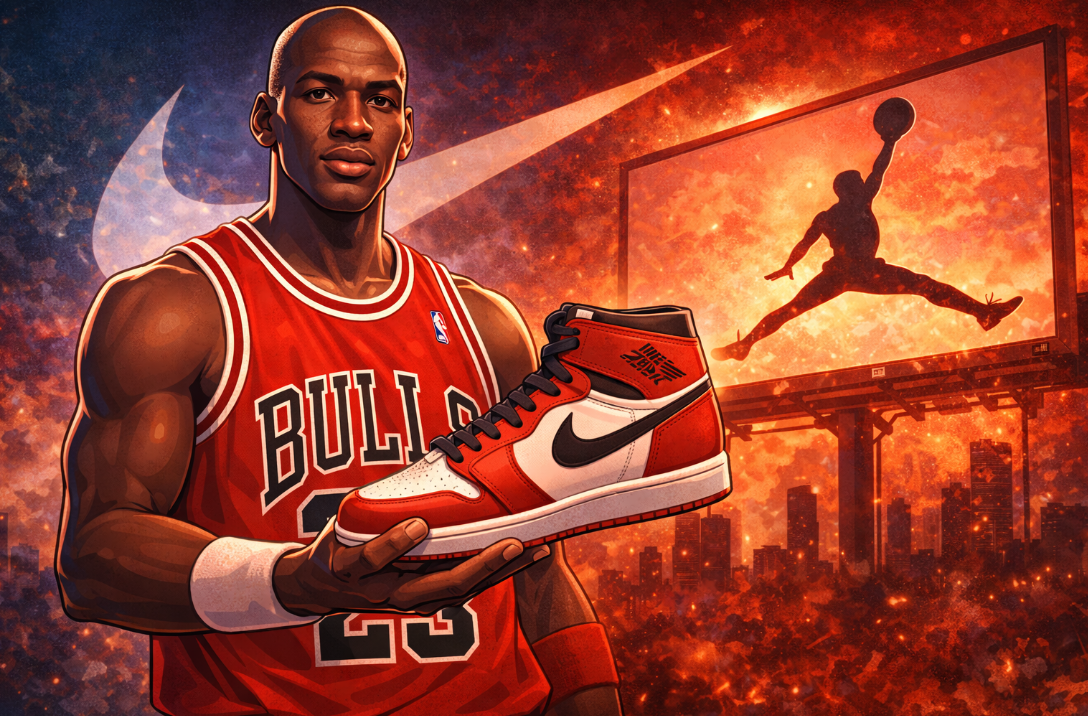
In 1984, before the jump shot became a logo and before a rookie ever took an NBA dribble, Sonny Vaccaro made one of the most consequential marketing bets in sports history: he convinced Michael Jordan to sign with Nike.
At the time, it didn’t look like genius. It looked like desperation.
Nike was an upstart in basketball, trailing industry leaders Adidas and Converse. Jordan preferred Adidas. Conventional endorsement logic said you spread risk across multiple athletes. Vaccaro argued the opposite: concentrate everything on one.
That decision wasn’t just bold; it was structurally different. Instead of treating Jordan as another endorser, Nike built an identity around him. The creation of the Air Jordan line marked a shift from product-first marketing to personality-first branding. The shoe wasn’t the hero. The athlete was.
From a sports marketing perspective, this was a category reset.
Vaccaro and Nike recognized something that the rest of the market hadn’t yet quantified: cultural resonance could outpace on-court résumé. Jordan was a rookie, but his style—his hang time, his charisma, his narrative—was already scalable. Nike didn’t just sell performance; it sold aspiration. In doing so, it tapped into a broader audience that extended far beyond basketball fans.
The strategy worked because it aligned three powerful levers:
- Scarcity. By focusing on one athlete, Nike created a sense of exclusivity.
- Storytelling. Jordan wasn’t just a player; he became a myth in real time.
- Risk tolerance. Nike committed its marketing budget in a way competitors wouldn’t.
Even early setbacks became assets. When the NBA effectively banned the original Air Jordan colorway, Nike reframed it as rebellion—turning regulation into marketing narrative. That instinct to convert friction into fuel remains a cornerstone of modern brand strategy.
The financial impact is well documented, but the deeper shift was philosophical. Before Jordan, endorsement deals were largely transactional: athletes lent credibility to products. After Jordan, athletes became platforms. The blueprint that now defines global sports marketing, from signature lines to lifetime deals, can be traced directly to this moment.
You see echoes of it in every modern superstar deal, from LeBron James’ long-term partnership structures to Kevin Durant’s brand extensions. The idea that an athlete can function as a standalone business unit, complete with narrative, design language, and cultural reach, wasn’t mainstream before 1984. Vaccaro helped make it inevitable.
But there’s a tension embedded in that legacy.
The same model that empowered elite athletes also accelerated the commercialization of sport at every level. Vaccaro himself would later challenge institutions like the NCAA, arguing that the system exploited young players whose market value had become undeniable. In a way, the Jordan deal exposed the gap between amateur ideals and professional realities.
That contradiction is part of the story, not separate from it.
Because what Vaccaro ultimately did wasn’t just sign a player. He identified a shift in how value is created in sports. Performance still matters, but narrative, identity, and cultural timing matter just as much.
Nike’s gamble on Jordan wasn’t simply about winning market share. It was about redefining the market itself.
And in doing so, it changed the math of sport forever.

"Marvelous" Marvin Nathaniel Hagler had knockout power in both hands. He could fight either southpaw or unorthodox, anything to keep Read more
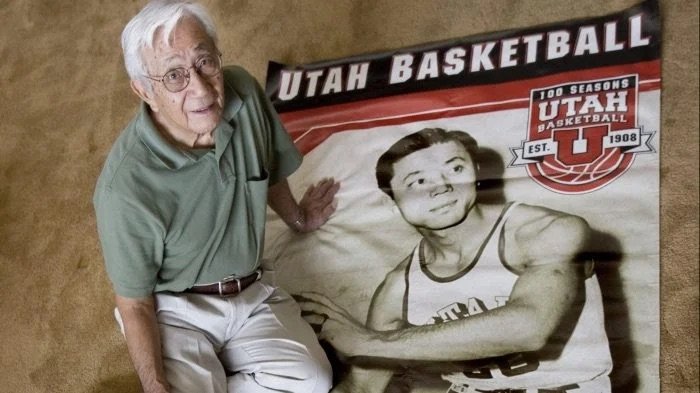
Wataru Misaka was 5-foot-7 and was drafted by the New York Knicks of the then BAA (Basketball Association of America), Read more

BaliPure Purest Water Defenders Head Coach Rommel Abella mentioned the word positionless, which is a word you normally associate with Read more
![Stephen Curry [photo credit: Wikimedia Commons | TechCrunch]](https://sportsbytes.com.ph/wp-content/uploads/2021/04/TechCrunch_Disrupt_San_Francisco_2019_-_Day_1_48835097887_cropped-scaled.jpg)
As the nation observes holy week, in my 45 years of existence, I've seen athletes both professional and amateur, wear Read more