by Vincent Juico
For nearly half a century, the McDonald’s All-American Game has served as basketball’s crystal ball.
It is an annual glimpse into the sport’s future before the names become household staples.
Since its debut in 1977, the game has evolved from a novelty showcase into a rite of passage. What began as a simple idea — bringing together the best high school seniors in America — has grown into one of the most prestigious stages in amateur basketball. The jerseys are temporary. The spotlight is not.
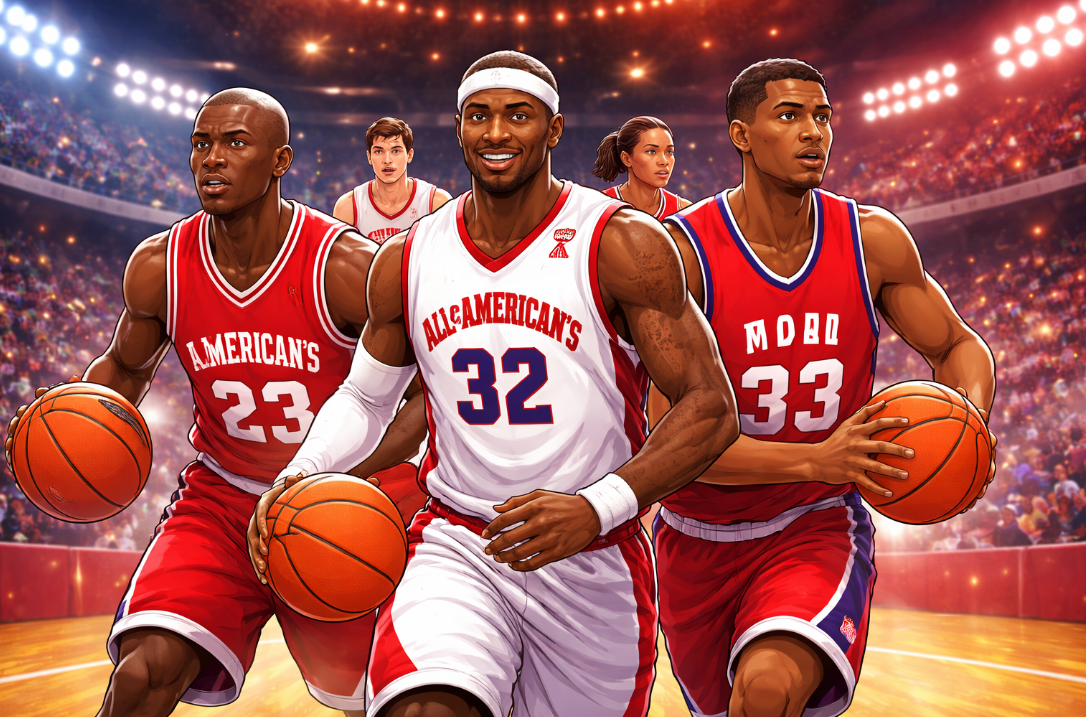
Scroll through its alumni list and it reads like a Hall of Fame roll call. Michael Jordan once took that floor as a teenager with promise but not yet legend. LeBron James arrived with unprecedented hype and somehow exceeded it. Kobe Bryant used it as a springboard before leaping straight to the NBA. Generations change, but the pattern remains.
Today’s McDonald’s All-American is tomorrow’s franchise cornerstone.
But the true story of the game isn’t just about star power; it’s about how the definition of “elite” has evolved.
In its early years, the selection process leaned heavily on traditional pipelines, with dominant college-bound players mostly from established basketball hotbeds. Over time, the scope widened. The rise of grassroots circuits, AAU culture, and national scouting networks transformed the game into a more accurate reflection of the country’s, and increasingly the world’s, best young talent. Athleticism exploded. Skill sets diversified. Positionless basketball crept in long before it became an NBA buzzword.
The game adapted, too. The introduction of the girls’ game in 2002 marked a significant shift, acknowledging that elite talent wasn’t confined to one side of the sport. Today, both games carry equal weight in shaping the next generation of stars, reinforcing basketball’s expanding global and cultural reach.
Yet for all its evolution, the McDonald’s All-American Game has always walked a fine line between showcase and substance.
Critics have long argued that it’s more spectacle than competition, that it is a glorified exhibition with limited defensive intensity and plenty of highlight hunting. And to an extent, that’s true. But that critique misses the point. This isn’t March Madness. It’s a preview. The value lies not in the final score, but in the first impression — how players move, think, and respond under a national spotlight for the first time.
It’s also one of the rare moments where future rivals share the same locker room. Before NBA battles, endorsement deals, and playoff legacies, there’s a brief window where the best prospects in the country are simply peers. That chemistry, however fleeting, often foreshadows the rivalries and partnerships that will define the league for years.
Perhaps the most fascinating aspect of the game’s 49-year history is its imperfection as a predictor. Not every McDonald’s All-American becomes a star. For every household name, there are players who plateau, fade, or take different paths entirely. That unpredictability is part of the intrigue. The game doesn’t guarantee greatness; it merely introduces the possibility of it.
And that’s why, nearly five decades on, it still matters.
Because every year, as the lights come on and the names are called, the question isn’t who will win; the question is, it’s who will become

Los Angeles Lakers superstar LeBron James has scored in double-digits for 1,000 consecutive games, a record he set as the Read more
LeBron James notched his 1st triple-double of the 2021 season on New Year's Day as the Los Angeles Lakers topped Read more
Steph Curry scored a game-high 26 points which included a big triple late as the Golden State Warriors snapped the Read more

Officially, I became a professional sportswriter on June 6, 1981, when my first materials on basketball, particularly about the NBA, Read more

- Basketball’s Annual Crystal Ball - March 29, 2026
- Justice Delayed, Career Denied - March 24, 2026
- Svitolina wins 2026 ASB Classic - January 14, 2026