By Henry Liao
Kindly allow this battle-scarred dinosaur to continue to turn back the hands of time in the world of Philippine basketball.
Most hoop fans worth their salt know something about the professional league Philippine Basketball Association, which first saw the light of day on April 9, 1975.
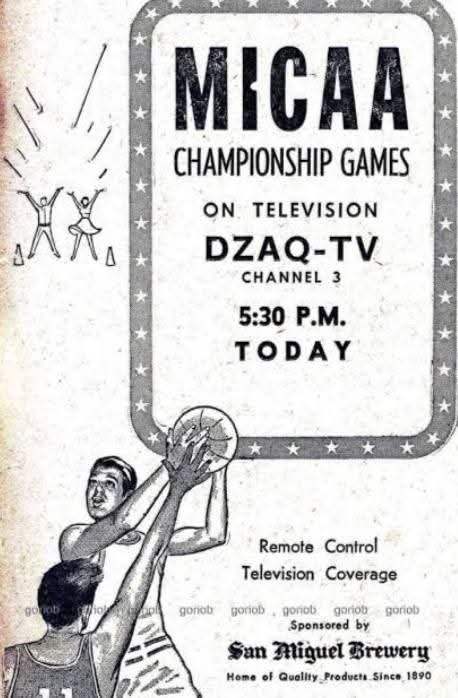
It came to being following the defection of nine member teams from the Manila Industrial and Commercial Athletic Association (MICAA), the premier post-graduate commercial league in the country that was established in 1938.
The MICAA had been organized by major companies dealing in sporting goods, apparel and equipment, and consumer products.
Among the original and longtime members were H.E. Heacock Incorporated, San Miguel Brewery, Philippine Air Lines, Elizalde and Company (represented by the Yco Redshirts/Painters owned by top sportsman Don Manolo Elizalde), Manila Yellow Taxicab Company (owned by businessman Felipe Monserrat, who later became the president of the then much-respected Philippine Amateur Athletic Federation, the forerunner of the Philippine Olympic Committee), Seven-Up Bottling Company, Ysmael Steel (represented by the YS Admirals owned by prominent industrialist Felipe “Baby” Ysmael), Chelsea, Yutivo Sons Hardware Company, Crispa-Floro, Universal Textiles, Puyat Steel, and Great Pacific Life Assurance Company.
Six clubs owned the distinction of capturing the MICAA crown (All-Filipino Conference or import-laced Open Conference) in their inaugural year in the league.
Heacock’s turned in the trick in 1938, Maurice Enterprises in 1946, Olympic Sporting Goods in 1947, Seven-Up in 1955, Mariwasa (owned by founding PBA president Emerson Coseteng, the father of future Senator Anna Dominique “Nikki” Coseteng) in 1968, and Toyota (owned by Don Pablo Carlos) in 1973.

The 1973 MICAA season was rocked by a report of the then-Philippine Constabulary Metrocom and a Basketball Association of the Philippines (BAP) special committee that accused six players from Crispa-Floro of involvement in game-fixing and point-shaving activities during the All-Filipino competitions.
In question was the best-of-three title-series opener where Mariwasa Akai downed star-studded Crispa-Floro. The Recorders went on to sweep the series, 2-0, against the Cement Mixers and snare their first-ever MICAA All-Filipino diadem behind legendary coach Valentin “Tito” Eduque.
For Eduque, who joined Mariwasa in 1971, it was his second MICAA crown with the franchise (the first came during the 1972 MICAA Open behind Americans Billy Robinson and Israel “Cisco” Oliver) and fifth overall (1964 with Yco and 1966 and 1967 with Ysmael Steel).
Eduque left for Concepcion Industries in the MICAA Open in 1973.
Notwithstanding the unsavory game-fixing incident that dominated the sports pages for months (just two years after Robert “Sonny” Jaworski and Alberto “Big Boy” Reynoso, a pair of national team members playing for Meralco, the 1971 MICAA Reinforced “Open” titlist, punched and kicked referee Jose Obias during a December 1971 All-Filipino game between the Reddy Kilowatts and the Crispa-Floro Redmanizers), the MICAA continued to enjoy great success for a year or two until a contentious disagreement with then-BAP president Gonzalo “Lito” Puyat led to the departure of the top clubs from the MICAA in March 1975 to form Asia’s first professional league, the PBA.
The MICAA still existed for some time, although as a “farm” league, until its demise in mid-1981 following the establishment of the Philippine Amateur Basketball League (PABL).

Officially, I became a professional sportswriter on June 6, 1981, when my first materials on basketball, particularly about the NBA, Read more
![Kai Sotto [FIBA.com photo]](https://sportsbytes.com.ph/wp-content/uploads/2021/01/4622.jpg)
Unlike Japeth Aguilar and Kobe Paras before him, Kai Sotto was not simply a walk-in, trying his luck in American Read more
![PH National Team that won the bronze in 1954 World Basketball in Rio de Janeiro. [Henry Liao photo]](https://sportsbytes.com.ph/wp-content/uploads/2021/01/144429345_221818172990075_1891445414791191084_n.jpg)
According to the famous historian and National Artist awardee Nick Joaquin, basketball was introduced to Filipinos within the historic walls Read more
![The 1954 Nationals that won the bronze medal in the 1954 World tournament. [Henry Liao photo]](https://sportsbytes.com.ph/wp-content/uploads/2021/02/144950691_774393143285027_3026363166572188338_n.jpg)
A dozen countries were in attendance in the 1954 edition – seven from the Americas, three from Europe and two Read more
- Before PBA, there was MICAA - April 9, 2026
- Only Five Players Won NCAA and NBA Titles Back to Back, Why PH Has Yet to See One - March 28, 2026
- KEEPING PACE: AGAINST ALL ODDS - March 21, 2026